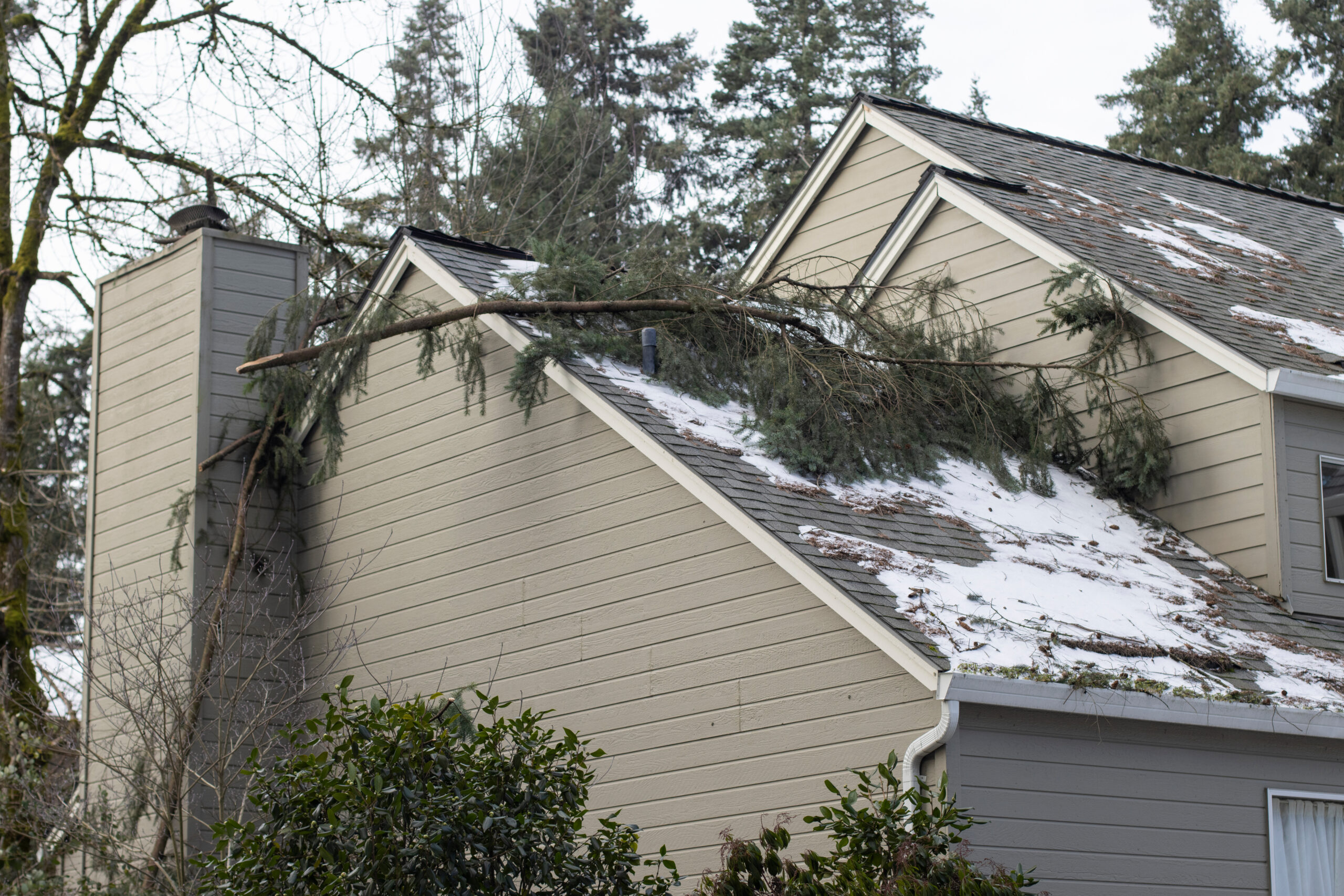
The wind picks up overnight, a branch comes down, and by morning there is a dark ring spreading across the ceiling that was not there yesterday. It is almost never a convenient hour.
What you do in the next 24 hours matters more than most homeowners realize. Not because you can fix the roof yourself, but because the sequence of safety, documentation, and stopping the water determines how much damage you end up paying for and how smoothly your insurance claim goes.
Here is that sequence, plus an overview of what emergency roof repair involves once a crew arrives, and why the phrase you want to hear is “drying in” rather than “we’ll throw a tarp on it.”
Hour One: Safety Comes Before the Roof
Nothing about your roof is worth an injury. Stay off it.
Stay off the roof during severe weather, and stay off it when it is wet, icy, or snow-covered. Wet shingles are slick, storm-damaged decking may not hold your weight, and the conditions that caused the damage are usually still present when homeowners are most tempted to climb up and look.
Work through the list below:
- Watch for downed power lines near the house or in contact with the roof, gutters, or trees. Call the utility, not a roofer.
- Keep away from water near electrical fixtures. If water is running through a light fixture or ceiling fan, shut off power to that circuit if you can do it safely.
- Do not stand under a bulging ceiling. A sagging or bubbling drywall ceiling means water is pooling above it. That is a collapse risk, and the weight involved is substantial.
- Contain what you can. Move furniture, electronics, and anything of value clear of the drip zone. Put buckets under active leaks and towels around them. Empty the buckets before they overflow.
One thing to be clear about: interior water containment is your job, not your roofer’s. Russell Quality Roofing does not provide interior protection services. Our work is on the roof, stopping water from getting in. What is already inside is handled by you and, if the damage is significant, a restoration company.
Hour Two: Document Before You Clean Anything
This is the step people skip, and it is the one that costs them. Photograph and video everything before cleanup, before repairs, before you move a single wet towel. Adjusters work from evidence, and evidence disappears the moment you tidy up.
Write down the storm details first. Date, time, and what the weather did. Wind, hail, heavy rain, snow load. If a specific storm caused the damage, that record is what ties your claim to the event.
Outside, capture:
- Wide shots of the house from each side for context
- Close-ups of every damage point you can see safely from the ground, including missing shingles, exposed decking, bent or displaced flashing, and punctures
- Your gutters, specifically any shingle granules collected in them, which is physical evidence of hail or severe wind impact
- Debris in the yard, such as a torn ridge cap or shingle fragments
Inside, capture ceiling stains, wet insulation, damaged belongings, and any dripping fixtures.
Then keep every receipt. The Washington Office of the Insurance Commissioner advises homeowners to save receipts for emergency repair materials, including things like tarps used to cover a damaged roof. Those mitigation expenses are frequently reimbursable, and they are frequently forgotten.
One more: do not throw out damaged property without your adjuster’s agreement, and do not authorize permanent repairs before the insurance inspection.
Hour Three: Call Your Insurance Company
Notify your insurer as soon as possible and get a claim number. Ask what documentation they need and confirm the next steps in writing.
Most homeowners policies require you to take reasonable steps to prevent further damage after a loss. That obligation is why emergency roof repair is treated differently from a scheduled replacement, and why getting the roof dried in promptly is usually in your interest and your insurer’s.
Russell Quality Roofing does not process or manage insurance claims. What we do is inspect the roof, document what we find, and provide the information your insurance company asks for. You contact your insurer and follow their claim process. If you decide to hire a public adjuster to represent you, the Washington Office of the Insurance Commissioner notes they must be licensed in Washington state.
What “Drying In” Means
Most emergency roofing companies stop at tarping. That is a mistake, and it is worth understanding the difference because it changes what happens to your house over the next several weeks.
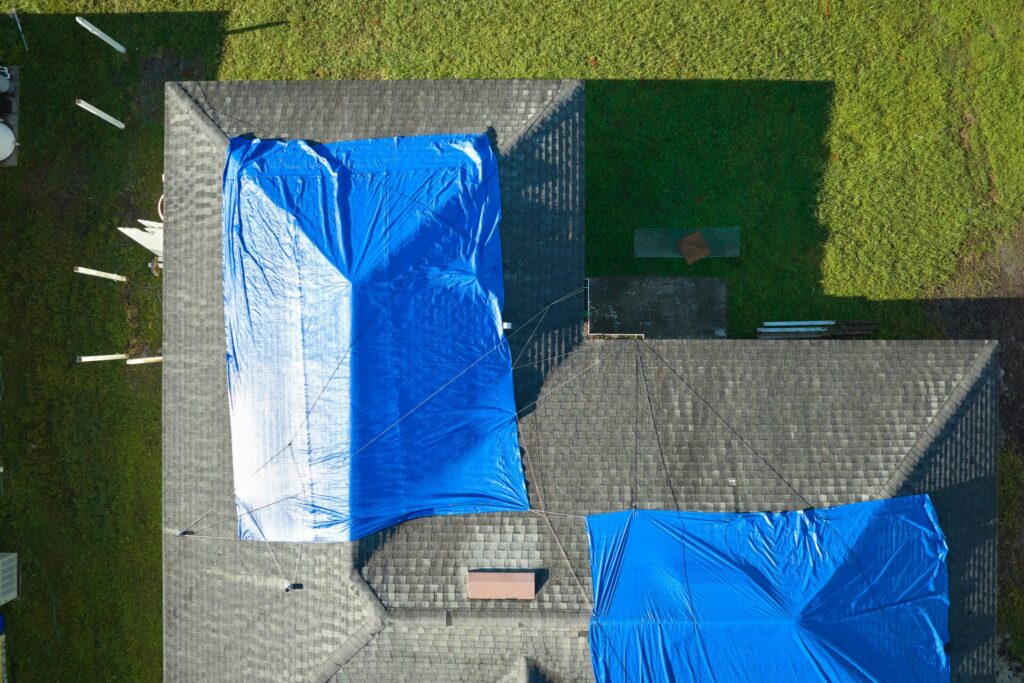
A tarp is a cover. It sits on top of the roof, gets fastened at the edges, and blocks rain for as long as the wind leaves it alone. In a real Inland Northwest storm cycle, that is often not very long. Wind gets underneath and peels it, fasteners create new penetrations, and the tarp that looked fine Tuesday is flapping over the ridge by Friday.
Drying in is a repair. It means making the affected roof plane weathertight from the deck up, using roofing underlayment and membrane secured to the substrate with flashing detailed where the water actually wants to go. It is temporary in the sense that finished roofing still has to go over it, but it is built like roofing rather than draped like a cover.
Russell Quality Roofing typically dries in affected areas rather than simply deploying tarps. Tarps may still be part of the process in some situations, and sometimes a tarp is the right call for a few hours until a crew can do the real work. But drying in is the primary method, and it is the reason our emergency work generally holds through the next weather event instead of needing to be redone.
Insurance inspections take time. Material lead times exist. A properly dried-in roof lets you move through that process without watching the ceiling every time the forecast turns.
If you are considering a DIY tarp, one safety point that is not negotiable: never weigh a tarp down with concrete blocks, bricks, or loose stone. Wind turns them into projectiles and they are a serious liability on any roof. If a tarp is going up, it needs to be properly fastened by someone with fall protection.
What Causes Most Emergency Roof Calls Around Here
Severe weather in the Inland Northwest produces a fairly predictable set of failures.
High winds tear off shingles and loosen flashing
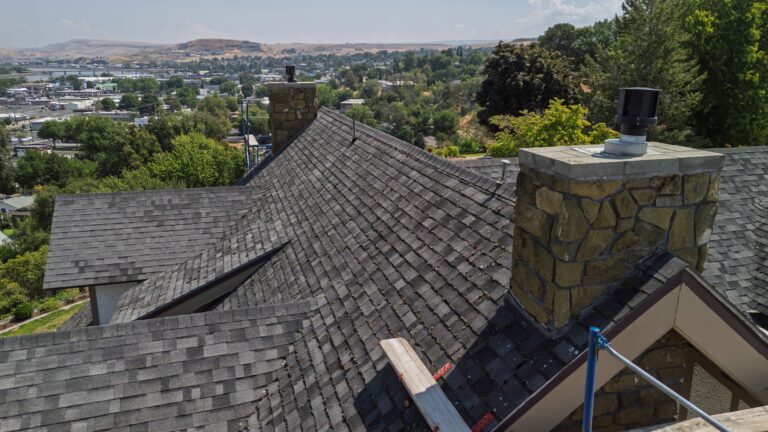
Missing shingles get the attention, but loosened flashing is often the bigger problem. Flashing is what keeps water out at chimneys, sidewalls, valleys, and every penetration on the roof. Failed flashing can cause major water intrusion during the next rain even when the shingle field looks untouched from the ground.
Tree branches create sudden punctures
A limb coming down does not gradually wear out a roof. It opens it, and water finds the opening within hours.
Hail bruises shingles invisibly
Spring and summer hail damage across the region frequently is not visible from the driveway. What shows up is granule loss in the gutters and, eventually, leaks.
Snow buildup traps moisture
Heavy snow that sits for weeks holds moisture against the roof, and ice damming at the eaves pushes water backward under the shingles. Moisture reaching the roof edges and gutters is a common winter source of interior staining, and the underlying cause is usually attic ventilation rather than the shingles.
Low-slope sections pond
On the flat and low-slope portions some homes and commercial properties have, standing water finds any weakness in the membrane.
The common thread is that a small opening quickly turns into an expensive problem. Water travels, and it does not stay in the room it entered. Moisture buildup in insulation and sheathing is what leads to rot and mold, and that damage is not visible until someone opens the assembly.
Emergency Roof Repair or Roof Replacement, How the Call Gets Made
Once the roof is dried in and the emergency is over, the real question is what happens next.
Targeted repairs make sense when the damage is isolated, the surrounding roof is in sound condition, and the deck underneath is dry. A punctured section, a torn area of shingles, or failed flashing on an otherwise healthy roof is often a straightforward repair. Sometimes it genuinely is a simple fix, and we will tell you that.
Replacement makes sense when the damage spans multiple planes, when the roof is already well into its service life, or when the sheathing has been wet long enough to be compromised. Patching an aging roof after every storm eventually costs more than replacing it once.
We trace observed leaks to identify the source and recommend the right fix. One caveat: active leaks can generally be traced during an inspection, but older or dormant leaks with no ongoing water intrusion are considerably harder to pin down. Any roofing contractor promising to find every leak regardless of age is promising more than the trade can deliver.
When replacement is the answer, every roof we replace includes a complete tear-off of the existing roofing materials. On a storm-damaged roof, seeing the deck is the entire point.
Do You Need a Permit for Emergency Roof Repair?
Usually yes for the permanent repair, and jurisdictions handle the emergency timing differently.
Spokane County addresses this directly. Permits are required before beginning work, but the county’s permit guidance states that when replacements and repairs must be performed in an emergency, the permit application is submitted to Spokane County Building and Planning on the next business day. Meaning, you do not need to wait on the paperwork while water comes through the ceiling.
The City of Spokane requires permits for roofing work, and its fee schedule values roofing permits per square, with different valuations depending on whether the job is a recover, a tear-off with new roofing, or a tear-off that also includes new sheeting. Spokane Valley requires permits for reroofing as well. On the Idaho side, Coeur d’Alene requires a re-roof permit, and Post Falls charges a flat fee for residential reroofs.
Remember to verify your contractor before anyone climbs a ladder, especially after a storm, when out-of-area crews tend to appear. In Washington, contractors must be registered with the state under RCW 18.27, and the City of Spokane treats that registration as a prerequisite for issuing a building permit. In Idaho, contractors performing work of $2,000 or more must be registered with the Idaho Contractors Board, and you can check status yourself through DOPL’s online services portal. Ask for proof of general liability and workers’ compensation too.
What Our Emergency Response Looks Like
We provide 24/7 emergency attention for residential and commercial properties. When you call, someone will get to you as quickly as possible. We do not publish guaranteed on-site timelines, because weather, road conditions, and how many properties are affected all shape what is honestly achievable after a regional storm event, and we would rather tell you the truth than a number.
What happens when a crew arrives:
- Assess safely. Crews are tied off with safety lines anchored at the ridge. Nobody goes onto an unstable or icy roof.
- Dry in the affected area so water stops entering the building.
- Document conditions with photos and video as needed, which we can provide to you for your insurance company.
- Build a repair plan. Targeted repairs or full replacement, with a single project-based estimate rather than a labor and material breakdown.
We specialize in Owens Corning asphalt architectural shingles and standing seam metal roofing, and we handle some commercial and residential low-slope applications. Installation work is performed by long-standing, vetted partner crews working to our standards and subject to our quality oversight, which is how we keep the work consistent whether it is a Tuesday afternoon repair or a 2 a.m. call after a windstorm.
The Days After: Not Just the First 24 Hours
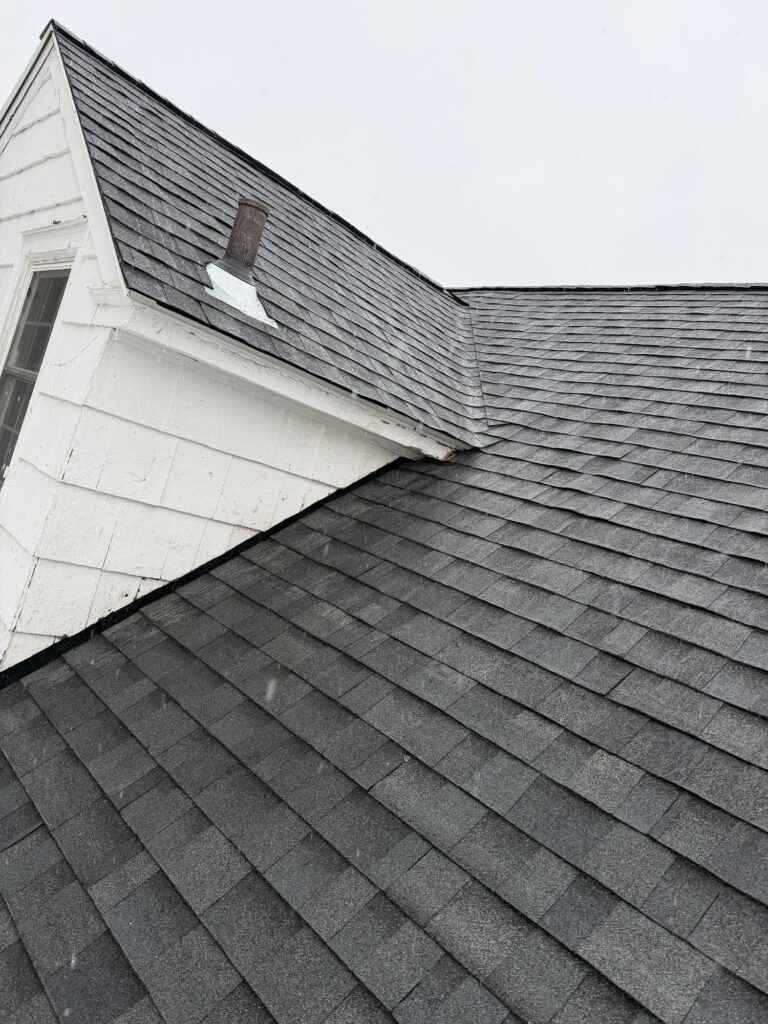
Check the attic with a flashlight once it is safe. You are looking for damp insulation, water staining on the underside of the sheathing, and daylight where there should not be any.
Watch the ceiling for several days. Water travels along framing before it shows itself, so a stain can appear well away from the actual entry point and days after the storm.
Clear the gutters so meltwater and rain have somewhere to go. If your gutters were damaged, we install continuous gutters formed on-site in the Lewis Clark Valley and surrounding areas.
Keep the paperwork together. Claim number, adjuster contact, photos, receipts, and your contractor’s estimate in one place. You will be asked for it more than once.
Common Questions About Emergency Roof Repair
Is emergency roof repair really available 24/7?
Yes. We provide emergency attention around the clock. What we will not do is promise a specific arrival window in advance, because after a regional storm the honest answer is “as quickly as we can get to you,” and typically that is same day.
Should I tarp the roof myself?
Only if you can do it from the ground or from a ladder without stepping onto a wet roof, which usually means the answer is no. If you do, fasten it properly and never weigh it down with blocks or bricks. Keep the receipt for the materials.
Will my insurance cover emergency roof repair?
That depends on your policy, your deductible, and what your carrier determines caused the damage. Sudden storm damage from wind or hail is commonly covered. Gradual wear is generally not. Contact your insurer directly, since we do not make coverage determinations or manage claims.
Can you work in rain or snow?
For drying in, yes, when conditions are safe. For finished roofing, the deck has to be dry and free of ice. Cold weather alone does not stop shingle installation. Rain, unsafe wind, and ice on the deck do.
My roof is not leaking yet, but a storm just came through. Should I wait?
Have it inspected. Wind and hail damage often does not produce a leak immediately, and the gap between damage and visible symptoms is where the expensive deterioration happens.
Call Before the Next Storm Finds the Same Crack
Russell Quality Roofing is a locally owned and operated company that has served the Inland Northwest since 2007. We are fully licensed, bonded, and insured, an Owens Corning Platinum Preferred Contractor ranked among the top one percent of roofing contractors nationally, with hundreds of five-star reviews from customers across the region.
We serve homeowners and businesses in Lewiston and Clarkston, Moscow and Pullman, Spokane and Spokane Valley including the South Hill, Liberty Lake, Airway Heights, Coeur d’Alene, Post Falls, Hayden, and surrounding areas.
If water is coming in right now, call (208) 791-5252. If the storm has passed and you want a fair assessment of what it left behind, schedule a free roof inspection or reach us through our free estimate form.
Russell Quality Roofing: Built on Trust, Backed by Expertise.