
A roof does not get rid of water. It relocates it, concentrated along a handful of edges. One inch of rain on a 1,000 square foot roof surface produces about 623 gallons of water. On a 2,000 square foot footprint, a single inch of rain sends roughly 1,250 gallons off the eaves. Every drop lands somewhere.
Gutter installation is the decision about where. Done well, that water leaves the property without touching your fascia, siding, or the soil against your foundation. Done poorly, it goes exactly where you would never choose to put it and can cause damage down the line.
What Do Gutters Protect?
Gutters protect three things you cannot easily replace:
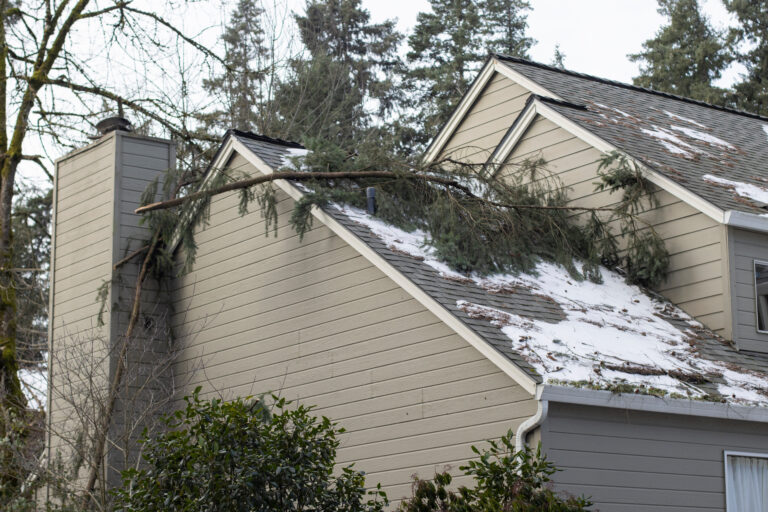
- The fascia and soffits are usually the first casualty of a failing system, since water overflowing the back of a gutter or leaking from a bad seam runs directly down into the wood behind it.
- Siding and window trim take repeated splash-back over the years.
- And the foundation is the expensive one: saturating the soil against a foundation wall season after season is how you get settling, cracking, and wet basements or crawl spaces.
Gutters are not universally required by code. The International Residential Code, Section R801.3 requires controlled roof water disposal discharging at least 5 feet from foundation walls, but only where expansive or collapsible soils are known to exist. That’s why some homes were built without gutters. The absence of a code mandate is not an argument against having them.
Seamless Gutters Versus Sectional
Sectional gutters come in pre-cut lengths and get pieced together on site, and every joint eventually gives up. Seamless gutters, also called continuous gutters, are formed on site from a coil to the exact length of each roofline run, so the only joints are at corners, end caps, and downspout outlets. Continuous gutters are what Russell Quality Roofing installs. We form them on site to fit the house rather than cutting stock lengths to approximate it.
Gutter Materials
Aluminum is the workhorse, and the reason seamless rain gutters are possible at all since it can be roll-formed on site. It resists rust and holds a baked-on finish well. Copper gutters are the premium option, extremely durable, can last well over 50 years, and develop a patina many homeowners specifically want, at a considerably higher cost in both material and soldering skill. Vinyl gutters are lightweight and cheap but get brittle in sustained cold and sag under snow load, and it’s not a material we’d put on an Inland Northwest home. Steel offers strength for heavy snow but is heavier, pricier, and can rust at cut edges as the coating ages.
K Style and Half Round
K style is the profile on the overwhelming majority of American homes. The flat back mounts directly to the fascia, and the shape holds more water per nominal size than a round gutter does. Half round gutters suit historic and architecturally traditional houses and shed debris more readily, but need to size up or add downspouts to match K style’s capacity. Five inch is standard; six inch is the answer for large roof planes, steep pitches, and homes with heavy runoff.
The Details That Decide Whether a System Works
This is where professional installation is worth it. Gutters need a slope of about a quarter inch of drop per 10 feet of run toward the downspouts. Too flat and water stands, adding weight and corroding the gutter from the inside. Plan on one downspout per 20 to 40 linear feet, adjusted for roof area and pitch, since undersized downspout count is the single most common cause of overflow. Hanger spacing matters more here than in mild climates, since ice and sliding snow put loads on a gutter that rain never will. Downspout elbows and extensions should carry discharge at least 3 to 6 feet from the foundation. And gutters need to work with the drip edge so water leaving the shingles lands inside the gutter rather than behind it, since water running behind a gutter is what rots fascia, invisible from the ground until the damage is done.
Why Gutters in the Inland Northwest Need More Than the Standard Approach
Ice damming happens when heat escaping into the attic melts snow at the ridge, and that meltwater refreezes and backs up at the colder eave. Clear gutters help, but the actual fix is attic ventilation and insulation, not the gutters themselves. Snow releasing off a metal roof plane carries real force, which is another reason for heavier brackets and tighter spacing below a standing seam roof. And conifer debris, pine and fir needles specifically, wedges into gutters and packs down into a mat that’s considerably harder to flush than leaves.
Gutter Guards, What They Do and Don’t
Gutter guards reduce how often gutters need cleaning and keep out nesting animals and larger debris. Micro mesh is generally the most effective against fine debris, foam is the least expensive and most prone to degrading, and reverse curve systems can overshoot in very heavy rain. The caveat: no guard is maintenance free. Fine debris and needles still accumulate on top of most systems, and some designs restrict flow enough to cause overflow during intense rainfall.

Signs Your Existing Gutters Need Replacement
- Sagging sections, or gutters visibly pulling away from the fascia
- Standing water sitting in the trough a day after the rain stopped
- Seam leaks, drips at corners, or staining below joints
- Peeling paint or soft spots on the fascia board behind the gutter
- Water marks or streaking on siding below the eave
- Erosion trenches or dead spots in landscaping under the roofline
- Overflow during moderate rain, not just downpours
- Any gutter you’ve re-sealed more than twice
Repeatedly repairing old gutters costs more over a few seasons than replacing them once, and it does nothing about the fascia damage happening behind them.
The Best Time for Gutter Installation Is During Roof Work
Gutter installation can absolutely be a standalone project, but pairing it with roofing work has a real advantage. During a roof replacement, the old gutters may have to come off anyway, the drip edge is fresh, and the fascia is exposed and can be inspected before anything covers it. Russell Quality Roofing handles continuous gutters, soffits, and fascia work alongside their roofing services, which lets us address the whole eave assembly as one system instead of three separate jobs with three companies pointing at each other.
How to Hire a Gutter Installer
Get multiple written estimates and compare what’s included, not just price per linear foot, since downspout count is the easiest place to make a bid look cheap. Ask what may carry an additional charge:
- Downspout extensions
- Gutter guards
- Fascia repair
- Removal of old gutters sometimes sit outside a base quote
Verify licensing and insurance, and ask how many years of experience the crew has with the specific material you’re choosing. Request written warranties covering both materials and workmanship, since a manufacturer’s finish warranty says nothing about whether the installation itself was done right. And ask about the specifics: slope, downspout count and placement, hanger spacing. A professional will have immediate answers.
When you’re weighing the competition, a past estimate that showed a lower number isn’t automatically the better deal if it left out downspouts, guards, or fascia repair. Compare full scope, not just the bottom line.
Common Questions About Gutter Installation
Do I need a permit for gutter installation?
Standard residential gutter installation generally does not require a building permit, since it doesn’t alter the structure. Requirements vary by jurisdiction, so it’s worth a quick call to your local building department if fascia or structural work is also involved.
How long does gutter installation take?
Most single-family homes are a one-day job. Larger properties or projects that include fascia repair can run longer.
Do I still need gutters if my roof has deep overhangs?
Overhangs reduce splash-back but don’t stop water from concentrating along the drip line and saturating soil near the house. They help. They’re not a substitute.
Can new gutters be installed without replacing the roof?
Yes, it’s regularly done as a standalone project. We recommend having the fascia and roof edge looked at first, since new gutters on compromised fascia is a short-term result.
Get a Quote and Understand What’s In It
Russell has served the Inland Northwest since 2007, and we specialize in gutter services built for this region’s snow, ice, and rain, not a generic national approach. We are licensed, bonded, and insured across Idaho and Washington, and Russell Quality Roofing brings the same care and attention to exterior water management as we bring to every roof we install.
If your existing gutters are sagging, overflowing, or leaving marks on the fascia, that’s worth looking at before the next freeze. Contact us at (208) 791-5252 or request a free estimate through our free estimate page, and we’ll walk the property, take measurements, and give you a free quote with the details spelled out.
Russell Roofing, Construction, & Excavation: Built on Trust, Backed by Expertise.